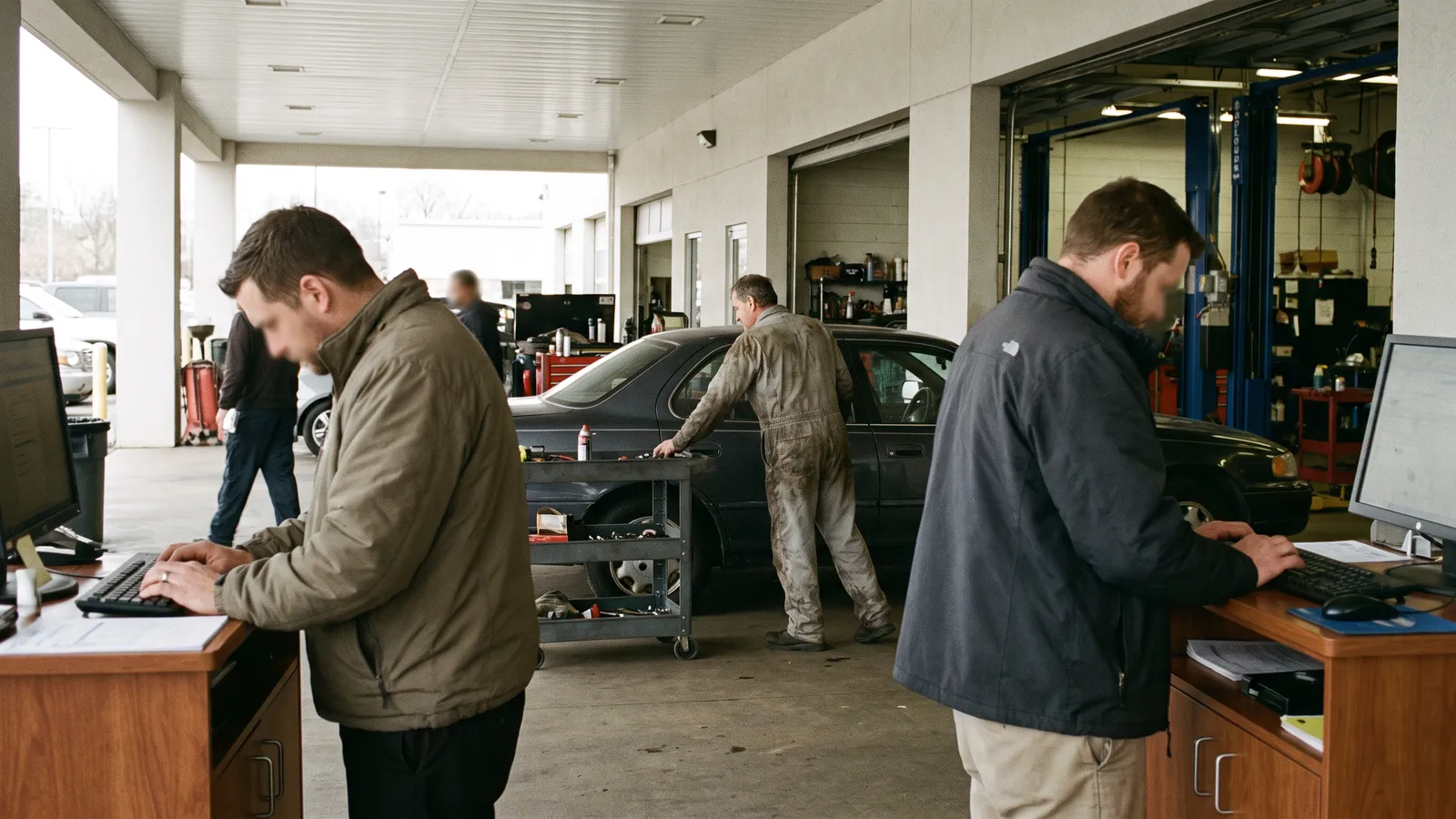
Walk through a dealership after closing and most of the day is already written down. The BDC logged every internet lead and the texts that followed, the sales desk sent numbers back and forth until a deal held, the service advisor typed the customer's complaint, the technician wrote the cause and the correction, and the parts counter quoted what was on the shelf. An independent repair shop keeps the same story in its repair orders and estimate approvals. Ten years of that shows how vehicles are sold, diagnosed and fixed, one decision at a time.
Some AI data buyers now sort sellers by industry. Polyshares names Automotive on its intake form, Mercor lists retail records such as inventory logs and listings, and Mode buys calls, CRM and billing records from US businesses with 20 or more office staff. None of the buyers we track has published an automotive deal yet, so any figure you hear for a store is an estimate until a buyer sees your records.
The delicate part of a dealership is the F&I office, where credit applications, identity documents and lender decisions live. In our reading, service write-ups, BDC call notes and the process documents the store wrote for itself are the easier place to start, and the F&I files are the ones to raise separately on the first call. Take the quiz to see which buyers take a store or shop your size.
Worth
What a dealership's data may be worth
Set for a typical dealership, 60 staff and 10 years of records. Move the sliders to match yours. Our estimate, not an offer.
Buyers
Which buyers want this data
Buyers whose own published rules fit car dealerships and auto repair shops. We can introduce you to the ones we work with.
Featured partners
micro1
Asks for SOPs, playbooks and CRM metadata, and a store's written road to the sale, desking rules and service menu fit that list.13
- $100K to $2M+, micro1 says8
Watch out for: Says it removes personal details only "when relevant", so ask exactly how.14
Polyshares
Lists Automotive on its intake form and asks for hours of recorded calls, the record a BDC and a service drive build every day.1,15
- $100K to $2M+, Polyshares says12
- None, Polyshares says16
- An offer in 1 to 2 weeks, then paid in 30 to 60 days17
Watch out for: Exclusive by default, and every deal it lists is exclusive with no end date.18,19
Mode
Buys calls and transcripts, CRM and billing records, and takes US businesses with 20+ full-time office staff; 9,809 US new car dealers have 30 or more employees.30,31,2
Watch out for: The program launched in October 2026 and has no deal record yet.35
Everyone else we reviewed
By score, with full reviews. We have no referral agreement with these companies, so we do not link out to them.
Mercor
Names retail among its industries and lists inventory logs and listings, the records a used car manager works from all week.20,21
Watch out for: It confirmed a cyberattack in 2026, and class actions followed.25,26
Nyne AI
Names service histories, estimates, invoices and jobs, which is what an independent shop's management system holds for every vehicle.27
- $100K or more, Nyne says28
Watch out for: Pays only after the dataset is accepted, and publishes no timeline.29
Who wants this
Do buyers want car dealerships and auto repair shops?
No buyer publishes prices by industry, but their own intake forms show which industries they rate higher.
- Troveo puts retail or e-commerce (our closest match) in its third of four demand tiers: "Standard buyer demand for your industry."36
- Polyshares takes automotive, without marking it premium.37
Which buyers take a dealership your size
Shown for 60 staff, a typical dealership. Ask whether contractors and part-time staff count.
micro1
Polyshares
No headcount rule; the length and texture of the record matter more40
Mode
20+ full-time US office staff (accounting firms 10+, law firms 6+)31
Pewter
20+ staff and 3+ years; by industry, from 10+ (healthcare) to 50+ (manufacturing, finance)41,42,43
Grepped
No headcount minimum stated44
Ventra
30+ US employees and 3+ years of records45
Mercor
None stated46
Troveo
No minimum stated; its estimator starts at 2047
Nyne
20+ US W-2 employees and 3+ years48
Endless
Roughly 30+ employees49
Supersoniq
50+ employees and 5+ years50
What buyers value
What in a dealership's records buyers value
What buyers look for in your records, and what to talk through with your buyer before anything leaves your systems.
| Data | Where it lives | Why a buyer values it | Raise with the buyer |
|---|---|---|---|
| Repair orders with complaint, cause and correction | DMS service module (CDK, Reynolds and Reynolds) or shop software (Tekmetric, Shopmonkey) | Each RO pairs what the customer said with what the technician found and what fixed it, often on the same VIN over many years. | VINs, customer names, phone numbers and addresses printed on every RO. |
| BDC call recordings and lead follow-up | Phone system and dealer CRM (VinSolutions, DealerSocket, Elead) | How a web lead is answered, qualified and turned into a showroom appointment, with the outcome logged against it. | Whether callers heard a recording notice, and caller names in the audio. |
| Sales desk and deal notes | Dealer CRM and desking tool | The back and forth on trade value, payment and price shows how a deal gets structured until the customer signs. | Credit scores and income figures that ride along inside deal notes. |
| Multi-point inspections and declined work | DMS, shop software or a digital inspection app | What was recommended, what the customer approved and what they declined: advising under a real budget, written down every visit. | Nothing specific |
| Warranty claims and parts orders | Parts module and the manufacturer's warranty portal | Claims written to a manufacturer's rules, with rejections and resubmissions, are skilled writing most stores never think of as data. | Manufacturer terms on warranty and portal records. |
| Process documents and training | Shared drive or a training platform | The written sales process, service menus and customer recovery scripts are the method the store wrote for itself, and SOPs and playbooks are on micro1's list. | Nothing specific |
| F&I menus and deal files | F&I menu software and lender portals | Shows how products are presented and how lenders answer, but the files hold credit applications and identity documents. | Whether any part of F&I belongs in scope at all, and who would strip it. |
A week of records
A week of data at a dealership
- Monday: the service drive opens with a line of write-ups, each a complaint in the customer's words and a promise time.
- Tuesday: technicians close repair orders with cause and correction notes, and the warranty claims go to the manufacturer.
- Wednesday: the BDC works a stack of overnight internet leads by phone and text, booking appointments for the weekend.
- Thursday: the used car manager reprices aged units and the desk logs offers on incoming trades.
- Saturday: the busiest sales day, with deal jackets, desk notes and customer follow-ups logged into the CRM.
Process
How it works with each buyer
In each buyer's own words. Where a buyer publishes nothing, we say so.
micro1
- Internal docs, SOPs and playbooks, knowledge bases, project management workflows, internal comms, templates, CRM and workflow metadata, task histories13
- 30 to 200 employees39
- $100K-$2M+ per data package; over $1M for unique data8
- PII removed "when relevant"14
- The company keeps ownership of its data and reviews samples before release51
- Not published
Polyshares
Mercor
Selling or closing
Selling or closing your dealership? License its data first
In our reading, dealerships change hands through buy-sell deals, and independent shops are sold to larger groups or close when the owner retires. The written record can be priced on its own: Spirit Airlines' internal archive drew separate bids from Google, Mercor and micro1. If a sale is coming, ask each buyer whether a license can close first and how it is shown to the acquirer. Pewter also takes companies that are winding down or closed, as long as the records still exist.3,4,5
FAQ
Car dealerships and auto repair shops: questions, answered
In our reading, the repair orders are the core, because each one records a complaint, a diagnosis and a fix. Nyne names service histories, estimates and invoices among the records it buys. Technicians score 48 out of 100 on O*NET's email scale, so by our reading the value sits in RO notes and estimates, not inboxes.27,7
Treat them as the last thing you offer. Polyshares says a third-party partner scrubs personal data before licensing, and Cognor Labs says account numbers and addresses are stripped, but credit files hold far more than names. Start with service and sales process records and raise F&I on its own.53,60
Every business is different, so this one is best talked through with the buyer you're working with. Their team goes over it with you before anything is signed.
Every business is different, so this one is best talked through with the buyer you're working with. Their team goes over it with you before anything is signed.
Every business is different, so this one is best talked through with the buyer you're working with. Their team goes over it with you before anything is signed.
Before you sign
Questions to talk through with your buyer
Every business is different, so these are best talked through with the buyer you're working with. Their team goes over them with you before anything is signed.
Questions for this kind of business
- How do the FTC Safeguards Rule and GLBA apply to F&I records in a licensed copy, and who checks the scrub?
- Does our DMS provider's agreement limit bulk exports for this use?
- Do OEM franchise or warranty terms cover service and warranty claim records?
- How do CCPA, GDPR, UK GDPR and state privacy laws apply, and is de-identified data still personal information?
- Do customer, vendor or platform contracts, NDAs or API terms restrict this?
- How does a license affect a sale of the business: reps and warranties, change of control, earnouts, exclusivity?
Questions for any buyer
- Is the license exclusive, and for how long?
- Can you sublicense the data, and to whom?
- Which AI labs will receive it, and will you tell us?
- How long do you keep it, and how is it deleted?
- What is your liability cap, and who indemnifies whom?
- Will the contract ban re-identification of people in the data?
- Who removes personal data, by what method, and do we approve it first?