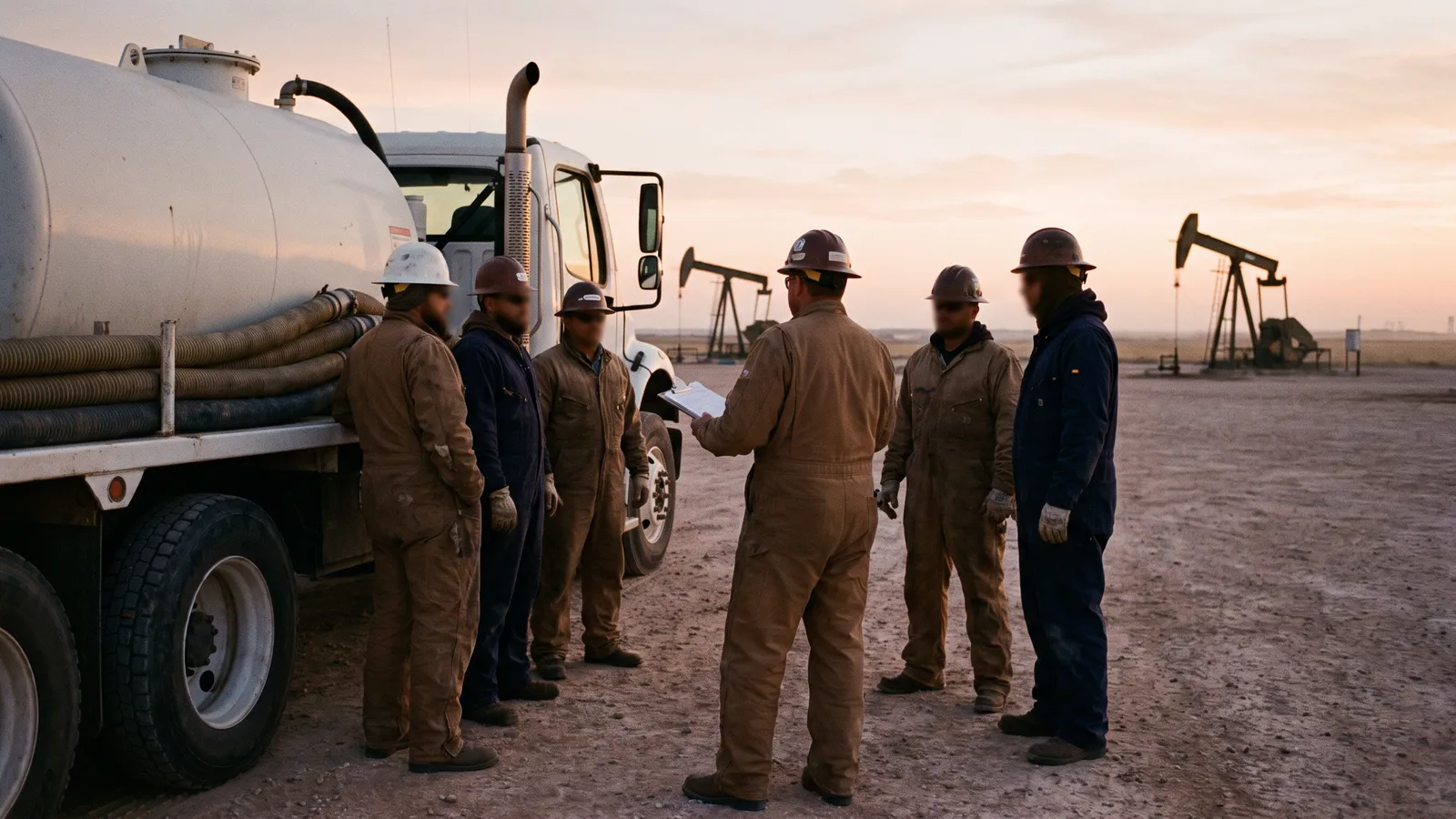
Field work in energy leaves a paper trail because it has to. An oil field service crew fills out a field ticket for every job, the toolpusher or supervisor writes a daily report, and each shift starts with a job safety analysis that names the hazards before anyone touches a valve. A line contractor works from a utility's job packet, logs storm restoration hour by hour, files as-builts when the poles are set and writes change orders when the ground was not what the drawings said. In the office, bids, safety investigations and customer emails tie it together.
Buyers do list the sector. Polyshares names Energy and utilities on its intake, Pewter lets visitors filter its list of 2026 deals by a Trades and energy sector, and Troveo's assessment puts construction and trades, the closest of its categories by our mapping, in its second tier of buyer demand. The only energy deal we can find published is Polyshares' solar license, so oil field and line work have no public price yet.
Two kinds of record need a careful look before any scope is set. Well data gathered on an operator's lease and a utility's system maps came from your clients, so they belong on the list of questions for the buyer you're working with, while the tickets, daily reports and safety files your crews wrote are, in our reading, the core. Take the quiz to see which buyers take a company with your headcount and years of records.
Worth
What a company's data may be worth
Set for a typical company, 90 staff and 12 years of records. Move the sliders to match yours. Our estimate, not an offer.
Buyers
Which buyers want this data
Buyers whose own published rules fit energy services companies, utility contractors and oil and gas service companies. We can introduce you to the ones we work with.
Featured partners
micro1
Asks for SOPs, templates and workflows employees repeat; a job safety analysis and a field ticket are filled out the same way every job.13,14
- $100K to $2M+, micro1 says10
Watch out for: Says it removes personal details only "when relevant", so ask exactly how.15
Polyshares
Lists Energy and utilities on its intake and has published a solar company license, which it files under Energy.1,2
- $100K to $2M+, Polyshares says11
- None, Polyshares says16
- An offer in 1 to 2 weeks, then paid in 30 to 60 days17
Watch out for: Exclusive by default, and every deal it lists is exclusive with no end date.18,19
Mode
Buys email, documents and accounting records from Outlook, Drive and QuickBooks, where bids, invoices and job files usually sit.20
Watch out for: The program launched in October 2026 and has no deal record yet.24
Pewter
Sorts its list of published deals by sector, including Trades and energy, and takes US firms with 20+ staff and 3+ years of records.25,26
Watch out for: Its site was registered in October 2026 and names no people.29,30
Everyone else we reviewed
By score, with full reviews. We have no referral agreement with these companies, so we do not link out to them.
Troveo
Puts construction and trades, our closest match for field energy work, in tier 2 of its assessment, the band it labels above-average buyer demand.31
- Six figures and up for a whole company, Troveo says32
- A share of the revenue; the percentage is not published33
Watch out for: You are paid from a revenue share, so ask what percentage you keep.33
Who wants this
Do buyers want energy services companies, utility contractors and oil and gas service companies?
No buyer publishes prices by industry, but their own intake forms show which industries they rate higher.
- Troveo puts construction and trades (our closest match) in its second of four demand tiers: "Your industry carries above-average buyer demand."31
- Polyshares takes energy and utilities, without marking it premium.34
- VMS, a broker, gives construction (our closest match) standard weight when it estimates value.35
Which buyers take a company your size
Shown for 90 staff, a typical company. Ask whether contractors and part-time staff count.
micro1
Polyshares
No headcount rule; the length and texture of the record matter more38
Mode
20+ full-time US office staff (accounting firms 10+, law firms 6+)39
Pewter
20+ staff and 3+ years; by industry, from 10+ (healthcare) to 50+ (manufacturing, finance)40,41,42
Grepped
No headcount minimum stated43
Ventra
30+ US employees and 3+ years of records44
Mercor
None stated45
Troveo
No minimum stated; its estimator starts at 2046
Nyne
20+ US W-2 employees and 3+ years47
Endless
Roughly 30+ employees48
Supersoniq
50+ employees and 5+ years49
What buyers value
What in a company's records buyers value
What buyers look for in your records, and what to talk through with your buyer before anything leaves your systems.
| Data | Where it lives | Why a buyer values it | Raise with the buyer |
|---|---|---|---|
| Field tickets and daily job reports | Field ticketing software, spreadsheets, scanned paper | What the crew did, with what equipment, for how long, and what went wrong, job after job. | Operator and lease names on each ticket. |
| Job safety analyses and tailgate meeting records | Safety app or paper forms | Hazards named before the work starts and the controls chosen, a rare written record of risk judgment. | Worker names and signatures on sign-in sheets. |
| Utility job packets and as-builts | Shared drive, utility portals, CAD files | The planned work set against what was actually built, with the reasons for every change. | Utility system maps and any infrastructure details the client treats as restricted. |
| Storm and outage restoration logs | Email, text threads, dispatch logs | Crews moved, priorities set and hours logged under pressure, with a clear start and end. | Nothing specific |
| Incident investigations and root cause reports | Safety management software, Word reports | How a company works back from an event to its cause and writes the fix, step by step. | Injured workers' names and any medical details. |
| Bids, change orders and customer correspondence | Outlook, accounting system | Pricing a job, defending a change and settling an invoice dispute with an operator or utility. | Nothing specific |
A week of records
A week of data at a company
- Monday: a frac support crew closes out a job, and the field ticket and daily report go to the office for billing.
- Tuesday: the safety manager files an investigation into a near miss on a pressure line, with a corrective action list.
- Wednesday: a line crew finishes a pole replacement and sends as-builts back with the utility's job packet.
- Thursday: a storm comes through overnight and restoration logs fill with crew assignments and outage counts.
- Friday: estimators bid next quarter's maintenance work and answer an operator's questions on last month's invoices.
Process
How it works with each buyer
In each buyer's own words. Where a buyer publishes nothing, we say so.
micro1
- Internal docs, SOPs and playbooks, knowledge bases, project management workflows, internal comms, templates, CRM and workflow metadata, task histories13
- 30 to 200 employees37
- $100K-$2M+ per data package; over $1M for unique data10
- PII removed "when relevant"15
- The company keeps ownership of its data and reviews samples before release50
- Not published
Polyshares
Selling or closing
Selling or closing your company? License its data first
When a service company is sold or shuts its yard, in our reading the trucks and contracts go first. The archive of tickets, safety files and job reports can outlast the equipment. Pewter takes companies that are operating, winding down or closed with 20+ people now or at their peak, and micro1's ads ask for closed companies that had 25+ employees at their peak, so a wind-down is not too late.3,4
FAQ
Energy services and utility contractors: questions, answered
No. Roustabouts score 42 out of 100 on O*NET's email scale against 100 for petroleum engineers, so the field record sits in tickets, daily reports and safety forms rather than inboxes, and the office holds the bids and correspondence.55
Every business is different, so this one is best talked through with the buyer you're working with. Their team goes over it with you before anything is signed.
Every business is different, so this one is best talked through with the buyer you're working with. Their team goes over it with you before anything is signed.
Before you sign
Questions to talk through with your buyer
Every business is different, so these are best talked through with the buyer you're working with. Their team goes over them with you before anything is signed.
Questions for this kind of business
- Does any record in scope count as critical energy infrastructure information, and who decides?
- Who owns well logs and production data gathered on an operator's lease?
- How are worker names, medical details and incident specifics removed from safety files?
- Who owns this data: the company, an estate, or someone else?
- Do customer, vendor or platform contracts, NDAs or API terms restrict this?
- Could the data include privileged material or trade secrets?
Questions for any buyer
- Is the license exclusive, and for how long?
- Can you sublicense the data, and to whom?
- Which AI labs will receive it, and will you tell us?
- How long do you keep it, and how is it deleted?
- What is your liability cap, and who indemnifies whom?
- Will the contract ban re-identification of people in the data?
- Who removes personal data, by what method, and do we approve it first?
Proof