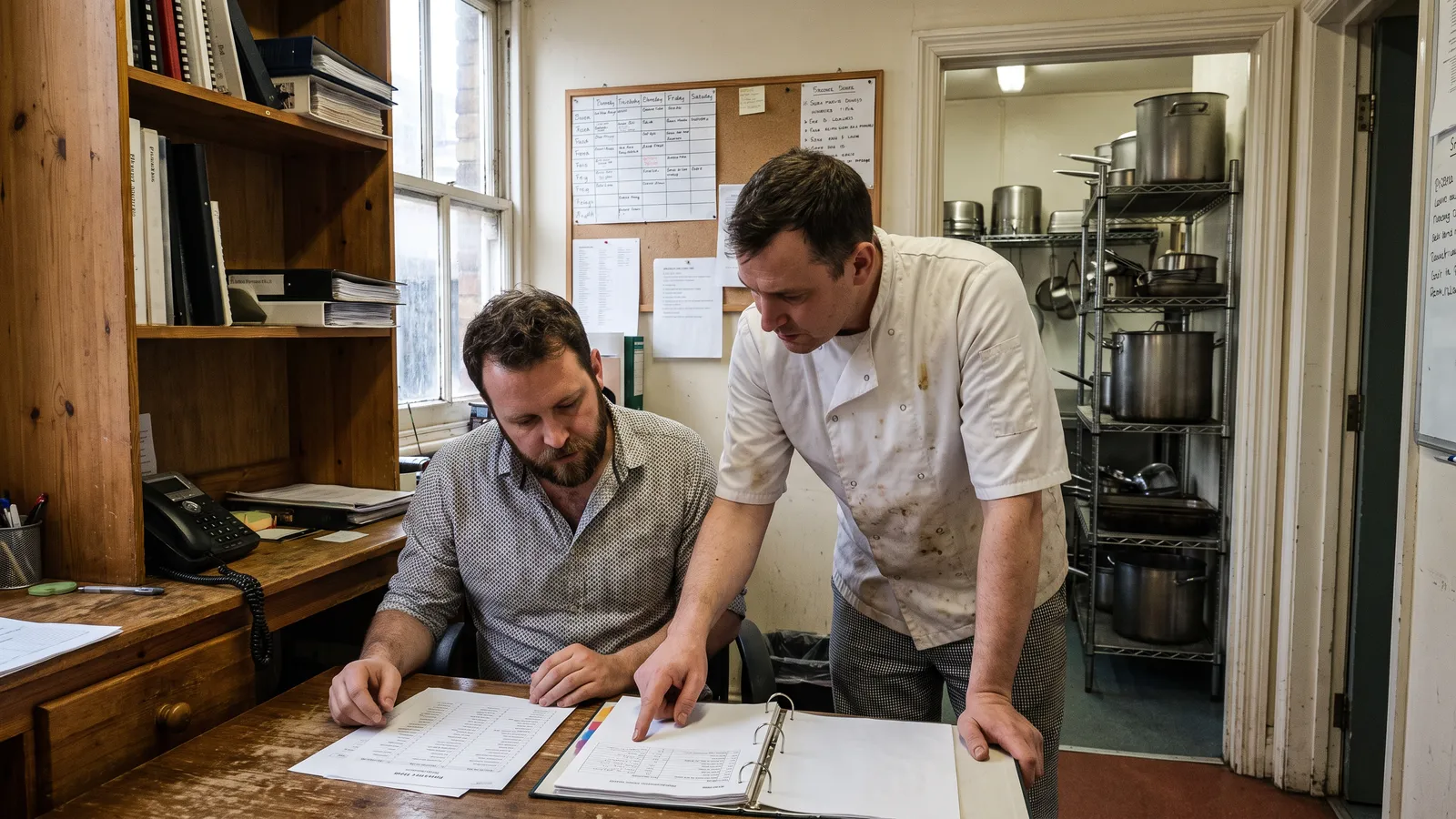
A restaurant runs on its point of sale, and the POS mostly records what sold. Toast's own export lists orders, payments, menu items and modifiers, kitchen times, cash, product mix and clock-ins, which is a ledger of the night rather than a record of anyone's judgment. The written side of a group lives above the dining room: the general manager's email to the ops director about a walk-in that died on a Saturday, the prep binders and recipe cards, the opening and closing checklists, the catering and private dining threads, the arguments with a produce vendor over short cases, and the franchise operations manual.
Be clear-eyed about demand. Troveo's estimator puts hospitality and restaurants in tier 4 of 4, its "lower today" band, and Polyshares lists restaurants and franchises without a premium flag. O*NET suggests why: chefs and head cooks score 97 out of 100 for how much of the job runs on email, food service managers 77, and servers only 20, so in our reading most of a single store's work never gets written down.
In our reading, where it can work is a multi-unit group or franchisee with an office doing purchasing, HR, catering sales and operations, because that team writes all day. Leave guest card data and staff files out, lead with SOPs and operations email, and take the quiz to see which buyers take a group your size.
Worth
What a group's data may be worth
Set for a typical group, 60 staff and 8 years of records. Move the sliders to match yours. Our estimate, not an offer.
Buyers
Which buyers want this data
Buyers whose own published rules fit restaurant groups and franchise operators. We can introduce you to the ones we work with.
Polyshares
Has restaurants and franchises on its intake list, sets no headcount floor and says the length and texture of the record matter more than size.1,11
- $100K to $2M+, Polyshares says9
- None, Polyshares says12
- An offer in 1 to 2 weeks, then paid in 30 to 60 days13
Watch out for: Exclusive by default, and every deal it lists is exclusive with no end date.14,15
Mode
Counts full-time US office employees, 20+ for most businesses, so the question for a group is how many people work above the stores.16
Watch out for: The program launched in October 2026 and has no deal record yet.20
Pewter
Takes US companies with 20+ full-time staff now or at their peak and 3+ years of records, including groups that are shrinking or have closed stores.3
Watch out for: Its site was registered in October 2026 and names no people.23,24
Grepped
States no size minimum and reads only the systems you approve, so a group can offer office mailboxes and the shared drive and keep the POS out.25,26
Watch out for: Its own site code calls its estimator "deliberately optimistic", so treat any estimate as an indication.27,28
Ventra
Takes US companies with 30+ full-time staff and 3+ years of history, and restaurants are not among the industries it says it is turning away.29,30
- $100K to $2M as potential deals, Ventra says31
- None today, though it may add fees with notice32
- An offer in 3 to 7 days, then paid on net 30 or 6031
Watch out for: Its terms say delivered data may not be deletable.33
Who wants this
Do buyers want restaurant groups and franchise operators?
No buyer publishes prices by industry, but their own intake forms show which industries they rate higher.
- Troveo puts hospitality, restaurants or local services in its lowest of four demand tiers: "Buyer demand for your industry is lower today."2
- Polyshares takes restaurants and franchises, without marking it premium.34
Which buyers take a group your size
Shown for 60 staff, a typical group. Ask whether contractors and part-time staff count.
micro1
Polyshares
No headcount rule; the length and texture of the record matter more11
Mode
20+ full-time US office staff (accounting firms 10+, law firms 6+)16
Pewter
20+ staff and 3+ years; by industry, from 10+ (healthcare) to 50+ (manufacturing, finance)37,38,39
Grepped
No headcount minimum stated25
Ventra
30+ US employees and 3+ years of records40
Mercor
None stated41
Troveo
No minimum stated; its estimator starts at 2042
Nyne
20+ US W-2 employees and 3+ years43
Endless
Roughly 30+ employees44
Supersoniq
50+ employees and 5+ years45
What buyers value
What in a group's records buyers value
What buyers look for in your records, and what to talk through with your buyer before anything leaves your systems.
| Data | Where it lives | Why a buyer values it | Raise with the buyer |
|---|---|---|---|
| Operations email between GMs, chefs and the ops director | Outlook or Gmail | Problems written up and solved in order: a short-staffed Friday, a failed cooler, an 86'd dish, a guest complaint escalated and closed. | Employee names, write-ups and discipline notes inside those threads. |
| Recipe cards, prep lists and kitchen SOPs | Google Drive, recipe costing software, scanned binders | Step-by-step procedures with yields and timing, the kind of SOPs and playbooks micro1 names on its list. | Signature recipes you would rather keep in the building. |
| Catering and private dining files | Tripleseat or email, BEOs and invoices | One written chain per event, from inquiry and menu choice through headcount changes to the final bill. | Guest names, phone numbers and company contacts on each event. |
| Purchasing and vendor correspondence | Email, purchasing or inventory app | Substitutions, credits for short or damaged deliveries, and the reasons a buyer switched suppliers. | Distributor pricing and rebate terms you agreed to keep private. |
| Franchise operations manual and field visit reports | Franchisor portal, SharePoint or Drive | How each store is supposed to run, set against what a field consultant found on the visit. | Whether the franchisor treats the manual and brand standards as its material rather than yours. |
| Guest feedback replies and reservation notes | OpenTable or Resy, review sites, the guest relations inbox | Complaints answered in writing, with what the manager offered and whether the guest came back. | Allergy and dietary notes tied to named guests. |
A week of records
A week of data at a group
- Monday: weekend recap emails from each GM covering covers, comps, call-outs and anything that broke.
- Tuesday: the purchasing lead disputes a short produce delivery by email and logs the credit.
- Wednesday: menu testing notes, updated recipe cards and a new prep list sent to every kitchen.
- Thursday: a private dining BEO revised twice as the client's headcount moves.
- Friday: shift swaps in the managers' group chat and an incident write-up after a busy service.
Process
How it works with each buyer
In each buyer's own words. Where a buyer publishes nothing, we say so.
Selling or closing
Selling or closing your group? License its data first
In our reading, restaurant groups sell units, refranchise stores and close locations often, and the buyer of a store is after the lease, the equipment and the brand rather than years of back-office email. Whether that email and the SOPs could be offered as a copy before a sale or a closing is a question to talk through with the buyer you're working with. Pewter takes companies that are downsizing, winding down or already closed if the records still exist.3
FAQ
Restaurant groups and franchise operators: questions, answered
In our reading, not much by itself. A Toast export covers orders, payments, menu items, kitchen times and clock-ins, which shows what happened but not why, and micro1's list of what it buys leads with internal docs, SOPs and internal communication. The POS helps as backing for those written records.49,50
Every business is different, so this one is best talked through with the buyer you're working with. Their team goes over it with you before anything is signed.
Every business is different, so this one is best talked through with the buyer you're working with. Their team goes over it with you before anything is signed.
Before you sign
Questions to talk through with your buyer
Every business is different, so these are best talked through with the buyer you're working with. Their team goes over them with you before anything is signed.
Questions for this kind of business
- Who controls the operations manual and recipes: the franchisor, the group, or the chef who wrote them?
- How are guest names, phone numbers and allergy notes removed from reservation and catering records?
- Does our POS provider's agreement limit what we do with exported sales data?
- How are employee data, union contracts and NLRA questions handled?
- Do customer, vendor or platform contracts, NDAs or API terms restrict this?
- How does a license affect a sale of the business: reps and warranties, change of control, earnouts, exclusivity?
Questions for any buyer
- Is the license exclusive, and for how long?
- Can you sublicense the data, and to whom?
- Which AI labs will receive it, and will you tell us?
- How long do you keep it, and how is it deleted?
- What is your liability cap, and who indemnifies whom?
- Will the contract ban re-identification of people in the data?
- Who removes personal data, by what method, and do we approve it first?