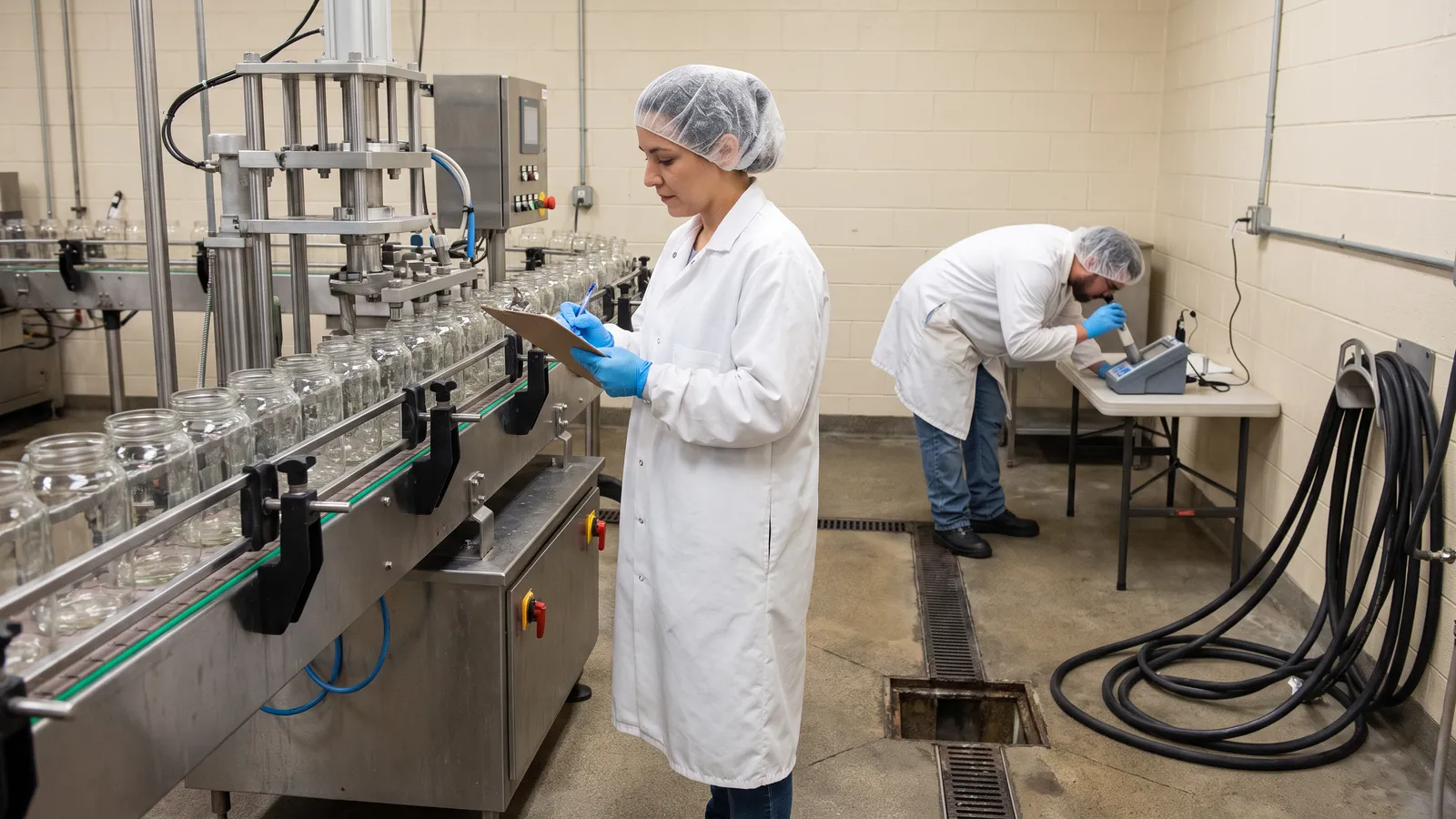
A food plant writes nearly everything down, because it has to. Each run produces a batch record with lot codes and weights, a QA hold when a metal detector trips or a pH reading drifts, sanitation and environmental swab logs, and the supplier certificates behind every ingredient. Around those sit the R&D notes from a reformulation, the spec sheets a retailer demanded, and the email with a broker or distributor about why a pallet missed its ship date.
Buyers now license copies of production and quality records, and food has started to appear by name. Polyshares lists food and beverage as its own intake industry, Mercor asks manufacturers for QA logs and spec sheets, and Cognor Labs, a broker, shows a food and beverage co-packer among its unnamed, unverified examples, with batch records, QA holds and sanitation logs as the records licensed. Troveo says buyers license work most readily when its result can be verified, and a lot that passed or failed release is a verified result.
Two piles need sorting before any call. A co-packer's batch records often carry the brand owner's formula and specs, and consumer complaint files carry names and addresses. Your own SOPs, sanitation procedures, supplier approval process and plant training are cleaner to offer first. The quiz shows which buyers take a producer your size.
- US food manufacturers with 10+ employees, 4,916 of them with 30+
10,6456
- US beverage makers with 10+ employees
4,6127
- Troveo's rank for manufacturing or industrial, the nearest category it lists for a food producer, by our mapping
Tier 2 of 48
- O*NET email score for food scientists; packaging line operators score 22
98/1009
Worth
What a company's data may be worth
Set for a typical company, 40 staff and 10 years of records. Move the sliders to match yours. Our estimate, not an offer.
Buyers
Which buyers want this data
Buyers whose own published rules fit food and beverage producers. We can introduce you to the ones we work with.
Featured partners
Polyshares
Lists Food and beverage as its own intake industry with no headcount floor, and excludes data held on behalf of clients, which matters for a co-packer holding brand owners' formulas.1,14,15
- $100K to $2M+, Polyshares says12
- None, Polyshares says16
- An offer in 1 to 2 weeks, then paid in 30 to 60 days17
Watch out for: Exclusive by default, and every deal it lists is exclusive with no end date.18,3
Pewter
Has Manufacturing on its offer form and says its licensing partner works with manufacturing and retail firms; it takes US firms with 20+ full-time staff now or at peak.25,26
Watch out for: Its site was registered in October 2026 and names no people.29,30
Grepped
States no headcount minimum, reads only the sources you approve and strips names, emails and phone numbers; its form has no food option, so by our reading a food company would pick Manufacturing or Other.31,32,33
Watch out for: Its own site code calls its estimator "deliberately optimistic", so treat any estimate as an indication.34,35
Ventra
Names manufacturing among the industries it says labs are buying from, and takes US companies with 30+ employees and 3+ years of records.36,37
- $100K to $2M as potential deals, Ventra says38
- None today, though it may add fees with notice39
- An offer in 3 to 7 days, then paid on net 30 or 6038
Watch out for: Its terms say delivered data may not be deletable.40
Everyone else we reviewed
By score, with full reviews. We have no referral agreement with these companies, so we do not link out to them.
Who wants this
Do buyers want food and beverage producers?
No buyer publishes prices by industry, but their own intake forms show which industries they rate higher.
- Troveo puts manufacturing or industrial (our closest match) in its second of four demand tiers: "Your industry carries above-average buyer demand."8
- Polyshares takes food and beverage, without marking it premium.41
- VMS, a broker, gives manufacturing (our closest match) standard weight when it estimates value.42
Which buyers take a company your size
Shown for 40 staff, a typical company. Ask whether contractors and part-time staff count.
micro1
Polyshares
No headcount rule; the length and texture of the record matter more14
Mode
20+ full-time US office staff (accounting firms 10+, law firms 6+)45
Pewter
20+ staff and 3+ years; by industry, from 10+ (healthcare) to 50+ (manufacturing, finance)46,47,48
Grepped
No headcount minimum stated31
Ventra
30+ US employees and 3+ years of records37
Mercor
None stated49
Troveo
No minimum stated; its estimator starts at 2050
Nyne
20+ US W-2 employees and 3+ years51
Endless
Roughly 30+ employees52
Supersoniq
50+ employees and 5+ years53
What buyers value
What in a company's records buyers value
What buyers look for in your records, and what to talk through with your buyer before anything leaves your systems.
| Data | Where it lives | Why a buyer values it | Raise with the buyer |
|---|---|---|---|
| Batch and production records | ERP or production software, paper batch sheets | Ingredients, weights, temperatures and times for every lot, with a release decision at the end. | Brand owners' formulas on co-packed runs. |
| QA holds, deviations and corrective actions | QA software, Excel or a paper log | A reading out of spec, the investigation that followed, and whether product shipped, was reworked or was destroyed. | Nothing specific |
| Supplier approvals, COAs and audit reports | Shared drive or a supplier portal | How you decide which ingredient sources to trust, document by document. | Ingredient pricing and audit reports written by a third party. |
| Sanitation and environmental monitoring logs | Paper logs, spreadsheets or QA software | Swab results, trends and the cleaning response, a checkable record of routine plant work. | Nothing specific |
| R&D and reformulation notes | Lab notebooks, Word and email | Trial batches, sensory results and the reasons a recipe changed. | Formulas you treat as trade secrets. |
| Retailer and distributor order threads | Outlook or Gmail, EDI portals | Spec changes, short shipments and deductions argued in writing. | Retailer terms and deduction amounts. |
| Consumer complaint files | Customer service inbox or CRM | What consumers reported and how each case was traced back to a lot. | Consumer names, addresses and any health details they wrote in. |
A week of records
A week of data at a company
- Monday: two production runs, each with a batch sheet showing lot codes, scale weights and cook temperatures.
- Tuesday: a metal detector trips, product goes on hold, and QA writes up the investigation before release.
- Wednesday: a new sweetener supplier sends its COA and audit report, and purchasing logs the approval decision.
- Thursday: R&D runs a reduced-sugar trial batch and records sensory panel notes against the current formula.
- Friday: environmental swabs come back, one zone needs a re-clean, and a retailer emails about a short shipment.
Process
How it works with each buyer
In each buyer's own words. Where a buyer publishes nothing, we say so.
Polyshares
Selling or closing
Selling or closing your company? License its data first
If you might sell the brand or the plant, ask each buyer whether a license is exclusive, for how long, and how that term would sit with a sale. Polyshares describes each of its four published deals as a perpetual exclusive license to the operational record, while Troveo says exclusivity is time-limited and has to be earned. One law firm says a license signed before a sale will also come up in the acquirer's diligence, so keep the scope on file.3,4,5
FAQ
Food and beverage producers: questions, answered
Every business is different, so this one is best talked through with the buyer you're working with. Their team goes over it with you before anything is signed.
Every business is different, so this one is best talked through with the buyer you're working with. Their team goes over it with you before anything is signed.
Before you sign
Questions to talk through with your buyer
Every business is different, so these are best talked through with the buyer you're working with. Their team goes over them with you before anything is signed.
Questions for this kind of business
- Do our co-manufacturing agreements give the brand owner rights in batch records, specs or test results?
- Do FSMA records, third-party audit reports (SQF, BRCGS) or retailer supplier terms carry confidentiality terms that reach this data?
- How are consumer names, addresses and health details in complaint files removed, and do we review a sample?
- How do CCPA, GDPR, UK GDPR and state privacy laws apply, and is de-identified data still personal information?
- Do customer, vendor or platform contracts, NDAs or API terms restrict this?
- Could the data include privileged material or trade secrets?
Questions for any buyer
- Is the license exclusive, and for how long?
- Can you sublicense the data, and to whom?
- Which AI labs will receive it, and will you tell us?
- How long do you keep it, and how is it deleted?
- What is your liability cap, and who indemnifies whom?
- Will the contract ban re-identification of people in the data?
- Who removes personal data, by what method, and do we approve it first?