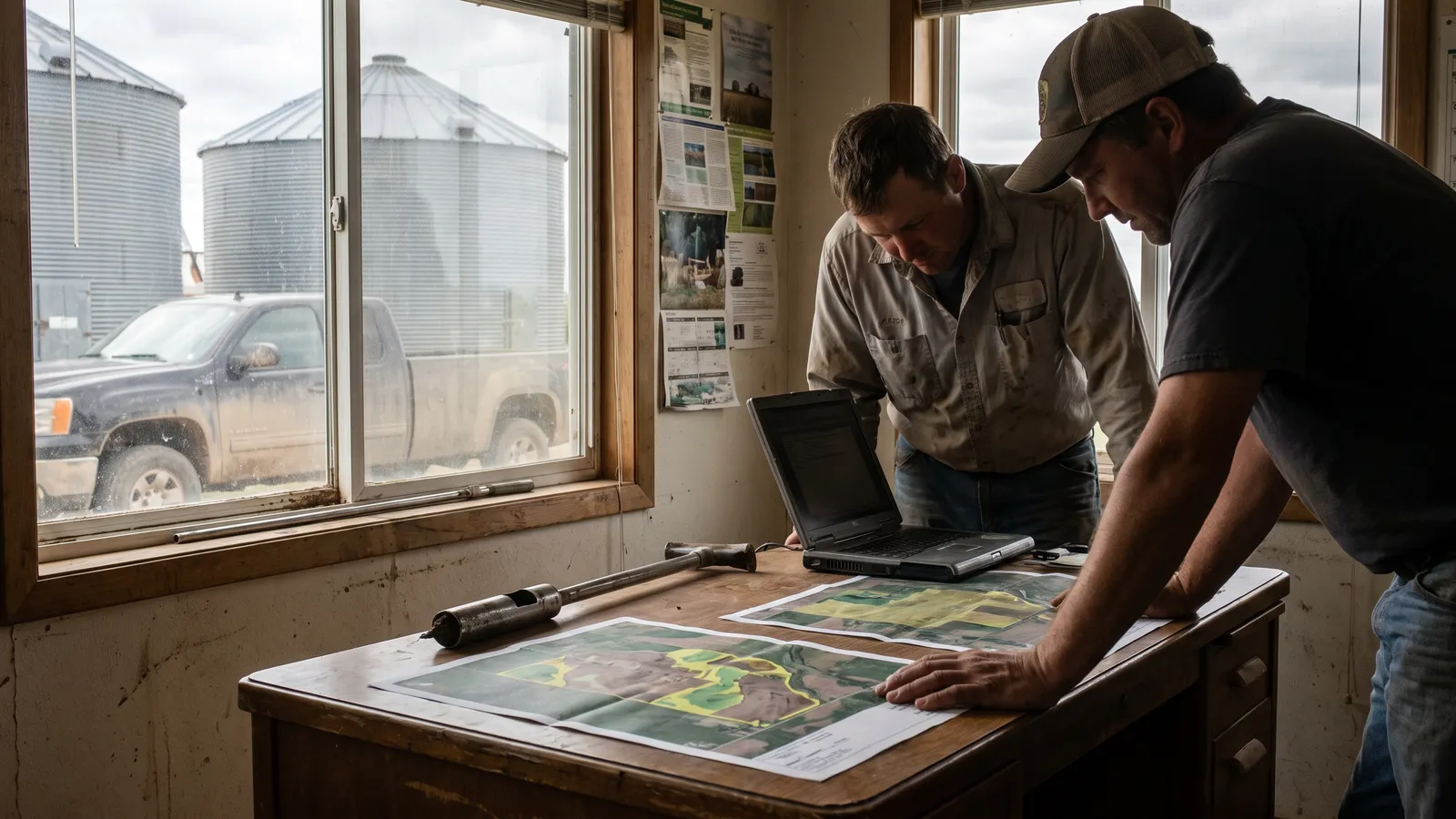
Agriculture runs on records that rarely leave the operation: an agronomist's scouting notes and the recommendation that followed, the application record for every pass over a field, yield maps from the combine, scale tickets and grain contracts at the elevator, input orders placed months ahead, and the maintenance log for equipment that cannot break during harvest. A co-op or ag service company adds grower email, dispatch for custom application and the reasoning behind each agronomy call.
By our reading, buyer demand here is thinner and harder to read than in manufacturing or freight. Polyshares is the one buyer we track that lists agriculture as its own intake industry. Troveo, Grepped and the broker VMS have no farm option, so an ag business picks Something else or Other on their forms, and Troveo puts that choice in its third of four demand tiers. Agriculture is not one of the nine sectors in OpenAI's GDPval benchmark, and O*NET scores farm managers at 60 out of 100 for email use, against 100 for farm product buyers.
So in our reading the strongest fit is the office side of agriculture: an agronomy firm, a grain or farm supply co-op, or a large operation whose managers do their work in writing. Size rules matter more here than elsewhere, because buyers count full-time or office staff and seasonal crews may not count at all. If that describes your business, the quiz shows which buyers will look at it.
Worth
What a operation's data may be worth
Set for a typical operation, 30 staff and 10 years of records. Move the sliders to match yours. Our estimate, not an offer.
Buyers
Which buyers want this data
Buyers whose own published rules fit farms, ranches and ag businesses. We can introduce you to the ones we work with.
Featured partners
Polyshares
The one buyer we track that lists Agriculture as its own intake industry, with no headcount floor; it says the length and texture of the record matter more than size.1,16
- $100K to $2M+, Polyshares says14
- None, Polyshares says17
- An offer in 1 to 2 weeks, then paid in 30 to 60 days18
Watch out for: Exclusive by default, and every deal it lists is exclusive with no end date.19,20
Pewter
Has Wholesale and distribution on its offer form, by our reading the closest fit for a co-op that sells inputs or markets grain, and counts 20+ full-time staff now or at peak.21,5
Watch out for: Its site was registered in October 2026 and names no people.24,25
Grepped
States no headcount minimum and reads only the systems you approve; an ag business would choose Other on its intake form.26,3,27
Watch out for: Its own site code calls its estimator "deliberately optimistic", so treat any estimate as an indication.28,29
Ventra
Lists wholesale and distribution among the industries it says labs are buying from, which by our reading covers a farm supply or grain co-op, and takes US companies with 30+ employees.30,31
- $100K to $2M as potential deals, Ventra says32
- None today, though it may add fees with notice33
- An offer in 3 to 7 days, then paid on net 30 or 6032
Watch out for: Its terms say delivered data may not be deletable.34
Everyone else we reviewed
By score, with full reviews. We have no referral agreement with these companies, so we do not link out to them.
Troveo
States no minimum headcount; an ag business would choose Something else, which its assessment puts in the third of four demand tiers.35,2
- Six figures and up for a whole company, Troveo says36
- A share of the revenue; the percentage is not published37
Watch out for: You are paid from a revenue share, so ask what percentage you keep.37
Who wants this
Do buyers want farms, ranches and ag businesses?
No buyer publishes prices by industry, but their own intake forms show which industries they rate higher.
- Troveo puts something else (agriculture is not listed) in its third of four demand tiers: "Standard buyer demand for your industry."2
- Polyshares takes agriculture, without marking it premium.38
Which buyers take a operation your size
Shown for 30 staff, a typical operation. Ask whether contractors and part-time staff count.
micro1
Polyshares
No headcount rule; the length and texture of the record matter more16
Mode
20+ full-time US office staff (accounting firms 10+, law firms 6+)41
Pewter
20+ staff and 3+ years; by industry, from 10+ (healthcare) to 50+ (manufacturing, finance)42,43,44
Grepped
No headcount minimum stated26
Ventra
30+ US employees and 3+ years of records31
Mercor
None stated45
Troveo
No minimum stated; its estimator starts at 2035
Nyne
20+ US W-2 employees and 3+ years46
Endless
Roughly 30+ employees47
Supersoniq
50+ employees and 5+ years48
What buyers value
What in a operation's records buyers value
What buyers look for in your records, and what to talk through with your buyer before anything leaves your systems.
| Data | Where it lives | Why a buyer values it | Raise with the buyer |
|---|---|---|---|
| Scouting reports and agronomy recommendations | Agronomy software, phone photos and email | What an agronomist saw in a field, what they recommended and why, season after season. | Grower names and field locations. |
| Application and field operation records | John Deere Operations Center, Climate FieldView or spreadsheets | Every pass over a field with product, rate and conditions, which harvest later checks. | Field data the platform's own terms cover. |
| Yield maps and harvest records | Combine monitors and farm management software | The result that tests every decision made earlier in the season. | Nothing specific |
| Grain contracts, scale tickets and settlement sheets | The elevator's grain system and email | How a sale was priced, delivered, graded and paid. | Producer names, prices and patronage details. |
| Input orders and grower email | Outlook or Gmail and the co-op's ERP | Questions from growers, product substitutions and delivery timing argued in writing. | Members' personal and financial details. |
| Equipment maintenance and repair logs | Shop notes, spreadsheets or a maintenance app | What failed in season, how long it sat, and how it was fixed. | Nothing specific |
| Herd and animal health records | Ranch management software or paper books | Breeding, weights, treatments and outcomes across years for a cattle or dairy operation. | Veterinary records and buyer pricing. |
A week of records
A week of data at a operation
- Monday: scouting crews upload field notes and photos, and the agronomist drafts recommendations for three growers.
- Tuesday: custom application is dispatched across the county, and each pass is logged with product, rate and wind speed.
- Wednesday: a grower emails about a fertilizer substitution, and the agronomy desk explains the change in writing.
- Thursday: the elevator takes in early loads, prints scale tickets and records moisture and grade on each one.
- Friday: a sprayer goes down mid-route, the shop logs the repair, and settlement sheets go out for the week's grain.
Process
How it works with each buyer
In each buyer's own words. Where a buyer publishes nothing, we say so.
Polyshares
Selling or closing
Selling or closing your operation? License its data first
If the farm passes to the next generation or the co-op merges with a neighbour, the office archive can outlast the business that made it, so decide who will hold it before land, equipment or the merger closes. Pewter takes firms that are operating, downsizing, winding down or closed as long as the records still exist, and micro1's closed-company ads ask for 25+ employees at the company's peak.5,6
FAQ
Farms, ranches and ag co-ops: questions, answered
Our read of O*NET's email scores is that the office side holds the written record: farm product buyers score 100 out of 100 and precision agriculture technicians 96, against 60 for farm managers. That points to agronomy firms, grain and farm supply co-ops, and larger operations with managers at desks.11
Every business is different, so this one is best talked through with the buyer you're working with. Their team goes over it with you before anything is signed.
Every business is different, so this one is best talked through with the buyer you're working with. Their team goes over it with you before anything is signed.
Before you sign
Questions to talk through with your buyer
Every business is different, so these are best talked through with the buyer you're working with. Their team goes over them with you before anything is signed.
Questions for this kind of business
- Do precision ag platform terms (John Deere Operations Center, Climate FieldView and similar) limit how exported field and yield data can be used?
- Do co-op bylaws, member agreements or landlord leases give anyone else rights in field records?
- How are grower names, field locations and H-2A worker records removed before any sample leaves the office?
- Who owns this data: the company, an estate, or someone else?
- How do CCPA, GDPR, UK GDPR and state privacy laws apply, and is de-identified data still personal information?
- Do customer, vendor or platform contracts, NDAs or API terms restrict this?
Questions for any buyer
- Is the license exclusive, and for how long?
- Can you sublicense the data, and to whom?
- Which AI labs will receive it, and will you tell us?
- How long do you keep it, and how is it deleted?
- What is your liability cap, and who indemnifies whom?
- Will the contract ban re-identification of people in the data?
- Who removes personal data, by what method, and do we approve it first?