Updated October 2026
Field reports and repair tickets from industrial service work have buyers
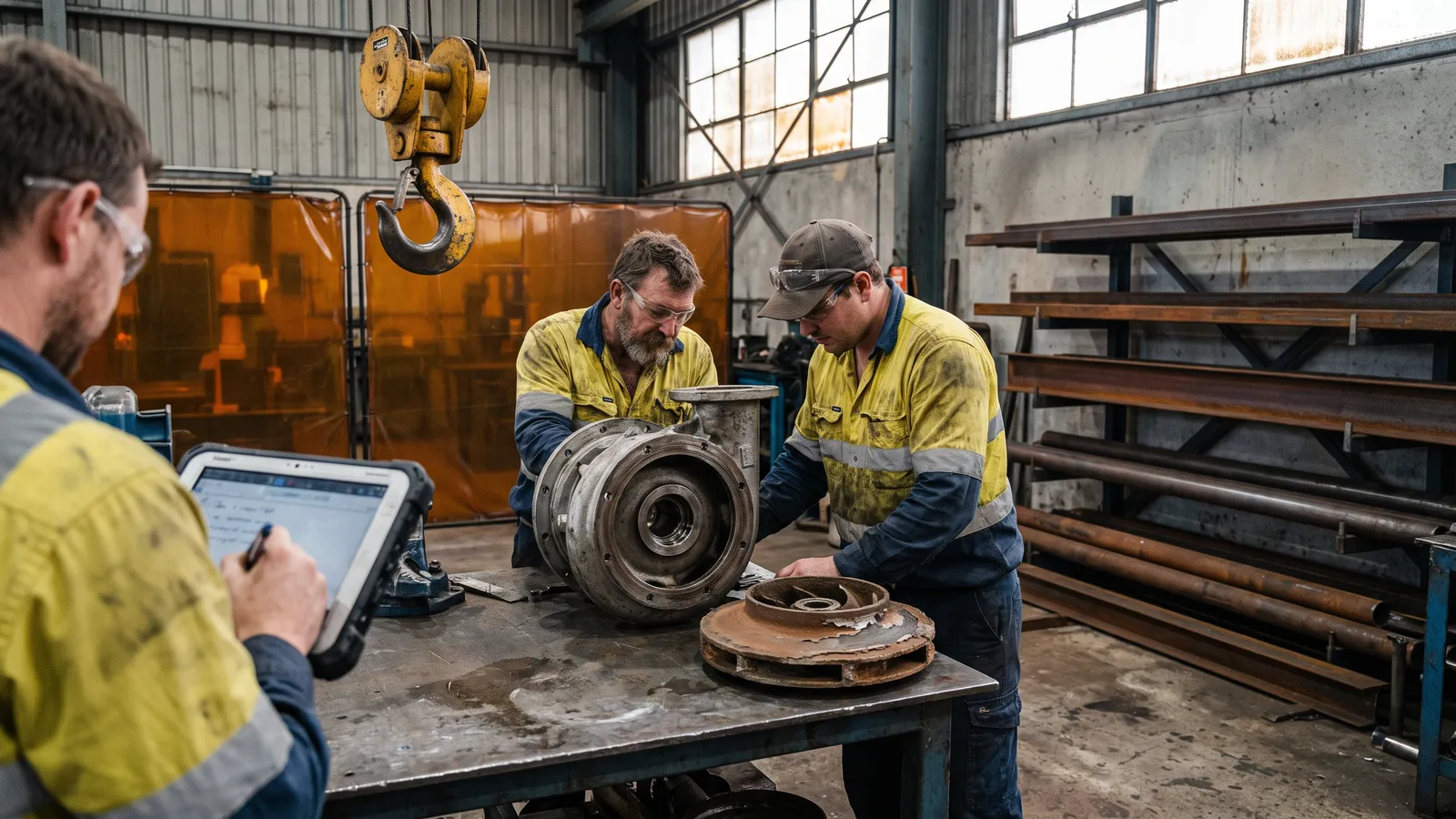
An industrial service company sells judgment under pressure. A pump at a customer's plant starts cavitating, a tech goes out and writes up what they found, a failure analysis follows, the repair is quoted, and the PM schedule changes so it does not happen again. Add the bid files for a plant shutdown, the job safety analyses, the weld procedures and inspection reports, and the time and material tickets argued over at month end, and a firm that has been in business twenty years holds a long written record of how equipment fails and how good crews fix it.
Buyers now license copies of records like these. Polyshares has a field operations category on its intake for work orders, dispatch, job tickets and site records, Ventra names both manufacturing and construction and trades, and Troveo's assessment puts manufacturing or industrial, and field service, the two categories closest to this work by our mapping, in its second of four demand tiers. Troveo also says work that can be checked against a result licenses most readily, and a repair that held, or failed again, is that kind of record.
Much of what you hold describes equipment at customers' sites, so the first sort is between your own methods (procedures, estimating logic, training, failure write-ups) and anything a customer gave you in confidence. Crews in the field also write less than the office does, so by our reading the service desk and estimators hold the richest files. The quiz shows which buyers take a company your size.
- US industrial machinery repair and maintenance firms with 10+ employees, 1,225 with 30+
3,7036
- US machine shops with 10+ employees
5,5327
- Troveo's rank for both manufacturing or industrial and field service, our two closest matches
Tier 2 of 48
- O*NET email scores for general maintenance workers and for industrial machinery mechanics
86 vs 489
Worth
What a company's data may be worth
Set for a typical company, 40 staff and 15 years of records. Move the sliders to match yours. Our estimate, not an offer.
Buyers
Which buyers want this data
Buyers whose own published rules fit industrial service companies. We can introduce you to the ones we work with.
Polyshares
Has a field operations category on its intake for work orders, dispatch, job tickets and site records, reading tools such as ServiceTitan, FieldEdge and Procore, and sets no headcount floor.2,14
- $100K to $2M+, Polyshares says12
- None, Polyshares says15
- An offer in 1 to 2 weeks, then paid in 30 to 60 days16
Watch out for: Exclusive by default, and every deal it lists is exclusive with no end date.17,18
Mode
Lists ServiceTitan among the sources it buys, along with email, documents and billing records, from businesses with 20+ full-time US office staff.19,20
Watch out for: The program launched in October 2026 and has no deal record yet.24
Pewter
Has Manufacturing and Trades and home services on its offer form, and takes US firms with 20+ full-time staff now or at peak.25,5
Watch out for: Its site was registered in October 2026 and names no people.28,29
Grepped
Lists manufacturing and construction on its intake form, states no size minimum, and takes task histories and business records from tools such as ServiceNow and Jira.30,31,32
Watch out for: Its own site code calls its estimator "deliberately optimistic", so treat any estimate as an indication.33,34
Ventra
Names manufacturing and construction and trades among the industries labs are buying from, lists engineering records such as drawings, test results and change logs, and takes US companies with 30+ employees.1,35,36
- $100K to $2M as potential deals, Ventra says37
- None today, though it may add fees with notice38
- An offer in 3 to 7 days, then paid on net 30 or 6037
Watch out for: Its terms say delivered data may not be deletable.39
Who wants this
Do buyers want industrial service companies?
No buyer publishes prices by industry, but their own intake forms show which industries they rate higher.
- Troveo puts manufacturing or industrial (our closest match) in its second of four demand tiers: "Your industry carries above-average buyer demand."8
- Polyshares takes manufacturing (our closest match), without marking it premium.40
- VMS, a broker, gives manufacturing (our closest match) standard weight when it estimates value.41
Which buyers take a company your size
Shown for 40 staff, a typical company. Ask whether contractors and part-time staff count.
micro1
Polyshares
No headcount rule; the length and texture of the record matter more14
Mode
20+ full-time US office staff (accounting firms 10+, law firms 6+)20
Pewter
20+ staff and 3+ years; by industry, from 10+ (healthcare) to 50+ (manufacturing, finance)44,45,46
Grepped
No headcount minimum stated31
Ventra
30+ US employees and 3+ years of records36
Mercor
None stated47
Troveo
No minimum stated; its estimator starts at 2048
Nyne
20+ US W-2 employees and 3+ years49
Endless
Roughly 30+ employees50
Supersoniq
50+ employees and 5+ years51
What buyers value
What in a company's records buyers value
What buyers look for in your records, and what to talk through with your buyer before anything leaves your systems.
| Data | Where it lives | Why a buyer values it | Raise with the buyer |
|---|---|---|---|
| Service tickets and field service reports | Field service software, CMMS or paper tickets | What the tech found, what they did and what they recommended, call after call. | Customer site names and equipment tag numbers. |
| Failure analysis and root cause write-ups | Word, PDFs and email | The reasoning that turns a broken part into a cause and a fix, the most checkable record a service firm keeps. | Nothing specific |
| Bids, estimates and shutdown plans | Spreadsheets, estimating software and email | How a scope became hours, crew size and a price, and how the job came in against it. | Customer pricing and rate sheets. |
| Weld procedures, inspection and NDT reports | Shared drive and QA binders | Qualified procedures and measured results, each with a pass or fail. | Inspection reports on customers' equipment. |
| Job safety analyses and lockout procedures | Safety software or paper JSAs | How a crew plans hazardous work before it starts, written step by step. | Injury reports and medical details. |
| PM schedules and equipment histories | CMMS such as Fiix, UpKeep or Limble | Years of service on the same machines, with each failure and the change that followed it. | Equipment data a customer shared in confidence. |
| Time and material tickets and change orders | Field app, ERP or QuickBooks | Extra work found on site, priced and argued over in writing. | Nothing specific |
A week of records
A week of data at a company
- Monday: an emergency call for a gearbox failure at a customer's plant, with the tech's notes and photos filed that night.
- Tuesday: the estimator builds a bid for a two-week shutdown with crew sizes, rentals and a day-by-day schedule.
- Wednesday: a failure analysis report goes to the customer tying the gearbox damage to a lubrication interval.
- Thursday: the welding foreman revises a procedure after a bend test, and the QA file records the result.
- Friday: T&M tickets are reconciled with the customer's maintenance planner, and two change orders are approved by email.
Process
How it works with each buyer
In each buyer's own words. Where a buyer publishes nothing, we say so.
Selling or closing
Selling or closing your company? License its data first
If a larger company buys your firm, its team can end up holding old systems it does not need, and License My Data names acquirers left with legacy systems after a carve-out among the sellers it works with. Selling first? One law firm says a license signed before the sale will come up in the buyer's diligence, so keep the scope on file. Pewter takes firms that are operating, downsizing, winding down or closed.3,4,5
FAQ
Industrial services and contractors: questions, answered
They take the industries around you. Ventra names manufacturing and construction and trades, Grepped lists manufacturing and construction, and Polyshares has a field operations category for work orders and job tickets. Pick the closest option on each form and describe the work on the first call.1,30,2
Records that end in an outcome: a failure analysis with the fix that held, an inspection with a pass or fail, a bid set against the hours the job took. Troveo says the more objectively work can be checked, the more readily it is licensed.55
On O*NET's email scale, general maintenance workers sit at 86 out of 100, industrial machinery mechanics at 48 and welders at 22. Our read is that the service desk, estimators and report writers hold most of a firm's written record, so start there.9
Every business is different, so this one is best talked through with the buyer you're working with. Their team goes over it with you before anything is signed.
Every business is different, so this one is best talked through with the buyer you're working with. Their team goes over it with you before anything is signed.
Before you sign
Questions to talk through with your buyer
Every business is different, so these are best talked through with the buyer you're working with. Their team goes over them with you before anything is signed.
Questions for this kind of business
- Which customer master service agreements or site access terms cover photos, drawings and inspection data from their plants?
- How are injury reports and medical details in safety files removed before anything is shared?
- Do union agreements or employee policies say anything about sharing crew timesheets and field notes?
- Who owns this data: the company, an estate, or someone else?
- How are employee data, union contracts and NLRA questions handled?
- Do customer, vendor or platform contracts, NDAs or API terms restrict this?
Questions for any buyer
- Is the license exclusive, and for how long?
- Can you sublicense the data, and to whom?
- Which AI labs will receive it, and will you tell us?
- How long do you keep it, and how is it deleted?
- What is your liability cap, and who indemnifies whom?
- Will the contract ban re-identification of people in the data?
- Who removes personal data, by what method, and do we approve it first?