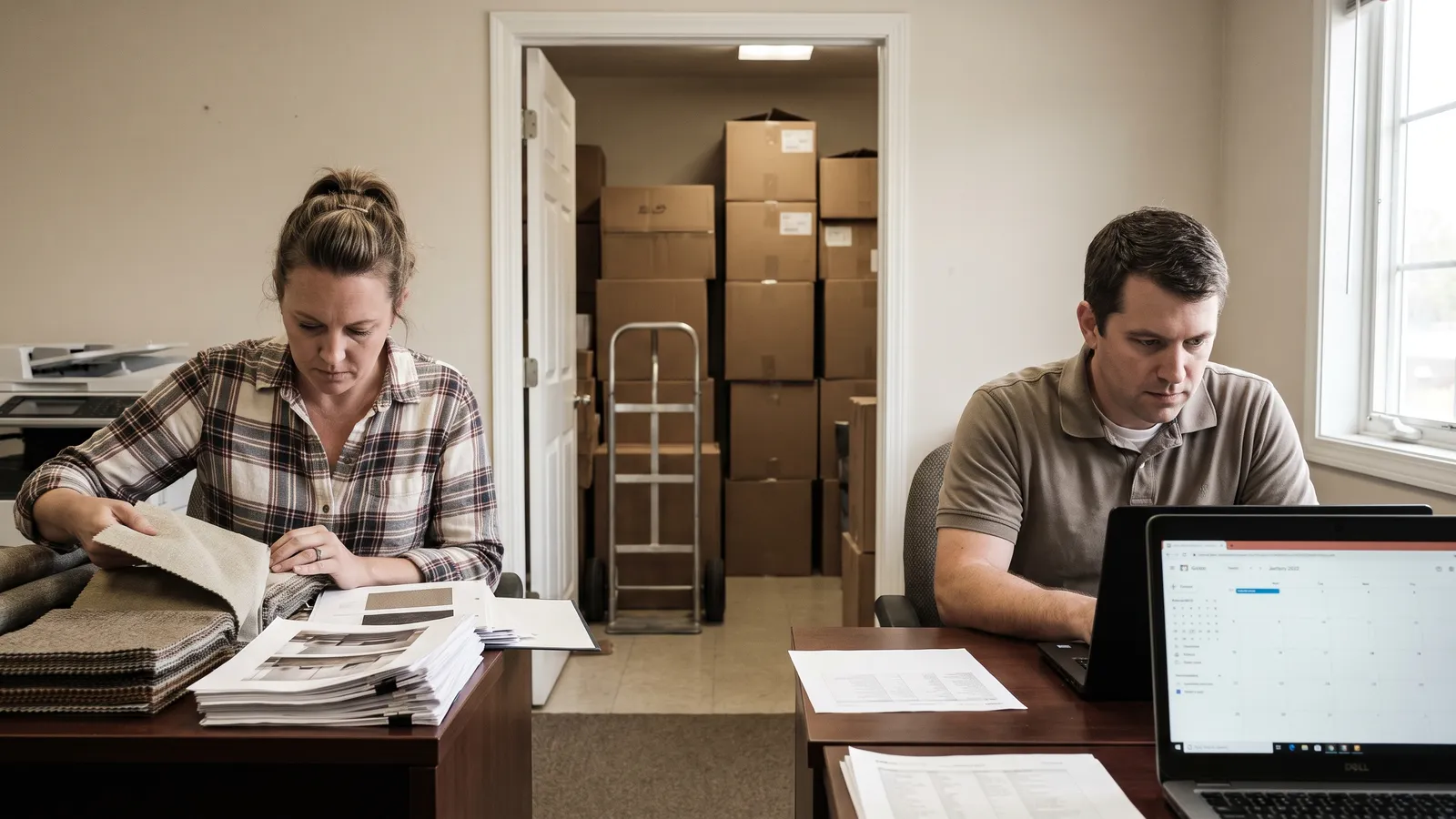
A store's register knows what sold, and the store's office knows why. The why is written down in special orders and layaway notes, delivery scheduling, warranty claims, the buyer's notes from a trade show, the open-to-buy spreadsheet, vendor email about late shipments and markdown support, and the returns desk's log. A multi-location retailer adds district manager visit reports, planograms, the store operations manual and the weekly call notes that tell every manager what to change.
In our reading, retail is on more buyers' lists than most consumer businesses. Mercor names retail and e-commerce and asks for order records, inventory logs and listings, Polyshares lists retail and ecommerce without a premium flag, and Troveo's estimator puts retail in tier 3 of 4, standard demand. OpenAI's GDPval benchmark counts retail trade among its nine sectors, and O*NET scores retail buyers 95 out of 100 on its email scale against 44 for cashiers, so by our reading the buying office is where the writing is.
This hub is for chains and big-ticket independents such as furniture, appliance, jewelry and sporting goods stores with an office behind the floor. Keep card data out, lead with buying and service records, and take the quiz to see which buyers take a retailer your size.
Worth
What a store's data may be worth
Set for a typical store, 45 staff and 10 years of records. Move the sliders to match yours. Our estimate, not an offer.
Buyers
Which buyers want this data
Buyers whose own published rules fit independent and multi-location retailers. We can introduce you to the ones we work with.
Featured partners
Polyshares
Lists retail and ecommerce on its intake and buys email, call recordings, tickets and ERP exports, where special orders and vendor disputes are kept.13,14
- $100K to $2M+, Polyshares says11
- None, Polyshares says15
- An offer in 1 to 2 weeks, then paid in 30 to 60 days16
Watch out for: Exclusive by default, and every deal it lists is exclusive with no end date.17,18
Mode
Buys email, calls, CRM and billing records, and counts full-time US office employees, 20+ for most businesses, not floor staff.25,26
Watch out for: The program launched in October 2026 and has no deal record yet.30
Pewter
Takes US firms with 20+ full-time staff now or at peak, including retailers that have closed stores or are winding down.5
Watch out for: Its site was registered in October 2026 and names no people.33,34
Ventra
Has advertised to furniture store owners, takes US companies with 30+ full-time staff and 3+ years, and says call recordings, tickets and email are in high demand.2,35,36
- $100K to $2M as potential deals, Ventra says37
- None today, though it may add fees with notice38
- An offer in 3 to 7 days, then paid on net 30 or 6037
Watch out for: Its terms say delivered data may not be deletable.39
Everyone else we reviewed
By score, with full reviews. We have no referral agreement with these companies, so we do not link out to them.
Who wants this
Do buyers want independent and multi-location retailers?
No buyer publishes prices by industry, but their own intake forms show which industries they rate higher.
- Troveo puts retail or e-commerce in its third of four demand tiers: "Standard buyer demand for your industry."8
- Polyshares takes retail and ecommerce, without marking it premium.40
Which buyers take a store your size
Shown for 45 staff, a typical store. Ask whether contractors and part-time staff count.
micro1
Polyshares
No headcount rule; the length and texture of the record matter more43
Mode
20+ full-time US office staff (accounting firms 10+, law firms 6+)26
Pewter
20+ staff and 3+ years; by industry, from 10+ (healthcare) to 50+ (manufacturing, finance)44,45,46
Grepped
No headcount minimum stated47
Ventra
30+ US employees and 3+ years of records48
Mercor
None stated49
Troveo
No minimum stated; its estimator starts at 2050
Nyne
20+ US W-2 employees and 3+ years51
Endless
Roughly 30+ employees52
Supersoniq
50+ employees and 5+ years53
What buyers value
What in a store's records buyers value
What buyers look for in your records, and what to talk through with your buyer before anything leaves your systems.
| Data | Where it lives | Why a buyer values it | Raise with the buyer |
|---|---|---|---|
| Special order, layaway and delivery threads | POS customer notes, email, delivery scheduling software | Long sales conversations carried through to delivery, with every reschedule and fix written down. | Home addresses and phone numbers on delivery tickets. |
| Buying and vendor correspondence | Outlook or Gmail, vendor portals | Allocation fights, late shipments, cancelled lines and the markdown and co-op support negotiated in writing. | Vendor cost prices and program terms you agreed to keep private. |
| Inventory logs and open-to-buy plans | POS and inventory system (Lightspeed, NetSuite and similar), spreadsheets | Inventory logs are on Mercor's list, and the open-to-buy shows how a buyer balanced budget, season and stock. | Nothing specific |
| Store operations manual, planograms and visual standards | SharePoint or Drive | How every store should open, merchandise and close, written for managers who were not there when the rules were made. | Nothing specific |
| District and store manager reports | Email, weekly call notes | What a district manager saw on a visit, what the store was told to fix and whether it did. | Named staff performance comments. |
| Returns, warranty claims and service calls | Phone system recordings, helpdesk, the returns log | Customer problems resolved over several steps with a written outcome, the records Ventra says are in high demand. | Card numbers, receipts and customers' contact details. |
A week of records
A week of data at a store
- Monday: the weekly managers' call notes, with markdown instructions and a planogram change.
- Tuesday: the buyer emails three vendors about late containers and moves a promotion back a week.
- Wednesday: delivery reschedules and a damaged-sofa claim worked through by phone and email.
- Thursday: the open-to-buy updated after a strong weekend in one category.
- Friday: district visit reports from two stores, each with a short list of fixes.
Process
How it works with each buyer
In each buyer's own words. Where a buyer publishes nothing, we say so.
Polyshares
Selling or closing
Selling or closing your store? License its data first
In our reading, when retailers close or sell, the customer file gets the most attention and the tightest limits: after state objections in RadioShack's 2015 bankruptcy, the buyer took 7 of 170 customer data fields. The buying files, procedures and vendor email are a different set of records, and whether a copy of them could be offered before stores are sold or closed is a question to talk through with the buyer you're working with. Pewter takes companies that are downsizing, winding down or closed if the records still exist.3,4,5
FAQ
Independent and multi-location retailers: questions, answered
If most sales come through Shopify or Amazon, the e-commerce hub fits better, since some buyers treat those platforms as a system type of their own. Polyshares' intake, for one, has an Ecommerce category naming Shopify, Amazon Seller Central, WooCommerce and BigCommerce.58
Every business is different, so this one is best talked through with the buyer you're working with. Their team goes over it with you before anything is signed.
Every business is different, so this one is best talked through with the buyer you're working with. Their team goes over it with you before anything is signed.
Before you sign
Questions to talk through with your buyer
Every business is different, so these are best talked through with the buyer you're working with. Their team goes over them with you before anything is signed.
Questions for this kind of business
- How are customer names, addresses, phone numbers and card details removed from delivery and service records?
- Do vendor programs or co-op agreements keep their terms confidential?
- Will our store name reach the AI lab that receives the data?
- How do CCPA, GDPR, UK GDPR and state privacy laws apply, and is de-identified data still personal information?
- Do customer, vendor or platform contracts, NDAs or API terms restrict this?
- How does a license affect a sale of the business: reps and warranties, change of control, earnouts, exclusivity?
Questions for any buyer
- Is the license exclusive, and for how long?
- Can you sublicense the data, and to whom?
- Which AI labs will receive it, and will you tell us?
- How long do you keep it, and how is it deleted?
- What is your liability cap, and who indemnifies whom?
- Will the contract ban re-identification of people in the data?
- Who removes personal data, by what method, and do we approve it first?