Updated November 2026
Your lab's test records, including the mistakes someone caught, licensed to AI buyers
Pewter says a US AI research lab asked it for about 20 runs of the same lab job, 3 to 5 of them with a documented problem.1
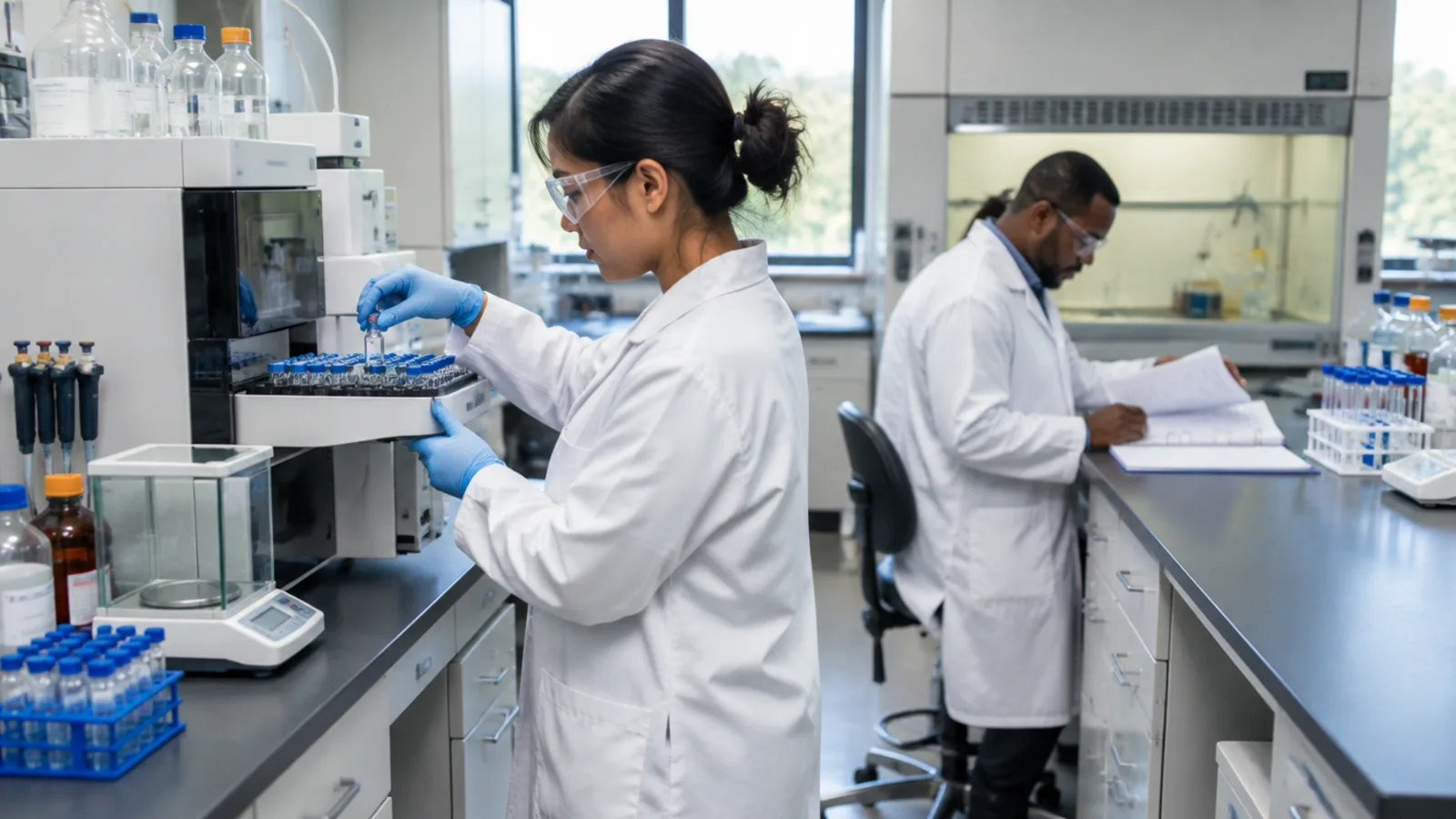
Most data buyers want email, chat and CRM records. This request is different. Pewter told its partners in October 2026 that a US AI research lab asked for complete records from working labs: the raw instrument files, the written procedure, the quality checks, the signed-off result, and the times something went wrong and someone caught it.
The unit is one kind of job done the same way about 20 times, with 3 to 5 runs where a problem was documented. That is a lab's ordinary routine: the same assay on every batch, the same control sample every shift, the same check against a reference. Pewter names manufacturers' own quality labs in food, chemicals, metals and plastics, water utilities and environmental agencies, university core facilities and research institutes, mining and exploration companies for their assay quality control, and proficiency-testing providers.
In our view the caught mistakes are the valuable part. Plenty of measurements are public; far fewer records show a careful analyst noticing a drifting instrument or a failed blank and working out why. This page covers which labs fit, what stays out, the records to look for, and the questions to raise before licensing anything.
Worth
What a lab's data may be worth
Set for a typical lab, 25 staff and 10 years of records. Move the sliders to match yours. Our estimate, not an offer.
Buyers
Which buyers want this data
Buyers whose own published rules fit testing and quality control labs. We can introduce you to the ones we work with.
Ventra
Lists engineering records, including test results and change logs, among the files labs look for.8
- $100K to $2M as potential deals, Ventra says9
- None today, though it may add fees with notice10
- An offer in 3 to 7 days, then paid on net 30 or 609
Watch out for: Its terms say delivered data may not be deletable.11
Polyshares
Lists Manufacturing, Food and beverage, and Agriculture as intake industries, where most in-house QC labs sit.12
- $100K to $2M+, Polyshares says6
- None, Polyshares says13
- An offer in 1 to 2 weeks, then paid in 30 to 60 days14
Watch out for: Exclusive by default, and every deal it lists is exclusive with no end date.15,16
Grepped
Lists Chemistry and materials, Semiconductors and Manufacturing among the industries on its intake form.17
Watch out for: Its own site code calls its estimator "deliberately optimistic", so treat any estimate as an indication.18,19
Pewter
Carries the US AI research lab's request for complete lab records, and checks whether a lab fits before anyone reaches out.1,3
Watch out for: Its site was registered in October 2026 and it does not name its licensing partner.22,23
Who wants this
Do buyers want testing and quality control labs?
No buyer publishes prices by industry, but their own intake forms show which industries they rate higher.
Which buyers take a lab your size
Shown for 25 staff, a typical lab. Ask whether contractors and part-time staff count.
micro1
Polyshares
No headcount rule; the length and texture of the record matter more26
Mode
30+ employees (accounting, finance and medical 10+, law firms 6+)27
Pewter
20+ staff and 3+ years; by industry, from 10+ (healthcare) to 50+ (manufacturing, finance)28,29,30
Grepped
No headcount minimum stated31
Ventra
30+ US employees and 3+ years of records32
Mercor
None stated33
Troveo
No minimum stated; its estimator starts at 2034
Nyne
20+ US W-2 employees and 3+ years35
Endless
Roughly 30+ employees36
Supersoniq
50+ employees and 5+ years37
Scale AI
40+ employees preferred, assessed case by case38
Replay
20+ full-time employees on its referral page; its valuation form accepts fewer39
Collinear
Best fit about 50+ people; smaller teams with deep records can work40
What buyers value
What in a lab's records buyers value
What buyers look for in your records, and what to talk through with your buyer before anything leaves your systems.
| Data | Where it lives | Why a buyer values it | Raise with the buyer |
|---|---|---|---|
| Raw instrument files | Chromatography, ICP, spectroscopy and balance software | What the instrument actually recorded, before any software calculated a result from it. | Files that only open in the manufacturer's software. |
| Standard operating procedures, every version | Document control system, shared drive | The method as written at the time of each run, and what changed when a procedure was revised. | Text copied from published test standards. |
| Quality control records | LIMS, control charts, calibration logs | Blanks, standards, duplicates and reference samples with known values: the checks that prove a run was right. | Nothing specific |
| Signed-off reports and certificates of analysis | LIMS, PDF reports | The answer the lab stood behind, with the limits each result was judged against. | Customer names and lot numbers on certificates. |
| Deviations, out-of-spec investigations and corrective actions | Quality system, email | The record of something going wrong and how someone noticed, which is the part this buyer prizes most. | Staff names and signatures in the write-ups. |
| LIMS audit trail and sample registers | LIMS | Who did what and when, linking each sample to its run and to the line in the final report. | Nothing specific |
A week of records
A week of data at a lab
- Monday: the morning control sample reads high on one instrument, so the analyst reruns the batch on the second instrument and logs both.
- Tuesday: twelve production lots assayed against specification, all passing, each with its blank and duplicate.
- Wednesday: a revised procedure goes live after a method review, and the old version is archived with the reason for the change.
- Thursday: a failed calibration standard stops a run; a fresh standard is prepared and the deviation form explains why.
- Friday: the quality manager signs the week's certificates of analysis and updates the control chart.
Process
How it works with each buyer
In each buyer's own words. Where a buyer publishes nothing, we say so.
Selling or closing
Selling or closing your lab? License its data first
When a plant consolidates its quality lab, a utility replaces its instruments, or a research institute closes a core facility, years of procedures, control charts and investigations can end up in an archive nobody opens. Pewter's buyer wants those complete records, problems included. Before anything is decommissioned, it is worth asking whether the archive could be licensed first.1
FAQ
Testing and QC laboratories: questions, answered
There is a live request. Pewter says a US AI research lab asked for complete records from working labs: raw instrument files, the written procedure, the quality checks, the signed-off result and the documented problems. It is a license of the records, arranged through Pewter.1
About 20 runs of the same job, done the same way, with 3 to 5 of them showing a problem that was documented and caught. Each run needs the raw files, the procedure in force, the quality checks and the signed-off result.1
Pewter names manufacturers' own quality labs in food, chemicals, metals and plastics, water utilities and environmental agencies, university core facilities and research institutes, mining and exploration companies for their assay quality control, and proficiency-testing providers.3
Pewter's buyer asks for 3 to 5 runs per job where something went wrong and someone caught it. In our view that is the point of the request: anyone can publish a clean result, but a record of an analyst spotting a drifting instrument or a failed check shows the judgement a model has to learn.1
Clinical and medical labs do not qualify. Pewter says anything about people does not work: patients, blood samples and clinical results are all out.44
No price is published yet. Pewter says pricing is set once the buyer confirms it.1
Every business is different, so this one is best talked through with the buyer you're working with. Their team goes over it with you before anything is signed.
Every business is different, so this one is best talked through with the buyer you're working with. Their team goes over it with you before anything is signed.
Every business is different, so this one is best talked through with the buyer you're working with. Their team goes over it with you before anything is signed.
Before you sign
Questions to talk through with your buyer
Every business is different, so these are best talked through with the buyer you're working with. Their team goes over them with you before anything is signed.
Questions for this kind of business
- Which records were produced for a client, under a grant, or with a partner?
- How are staff names, initials and signatures replaced across every file?
- Which text in our procedures is copied from a published standard?
- Who owns this data: the company, an estate, or someone else?
- Do customer, supplier or platform contracts, NDAs or API terms restrict this?
- Do professional rules apply (AICPA, IRC 7216, HIPAA, ABA Model Rule 1.17, insurance agency contracts, adviser rules, state boards)?
Questions for any buyer
- Is the license exclusive, and for how long?
- Can you sublicense the data, and to whom?
- Which AI labs will receive it, and will you tell us?
- How long do you keep it, and how is it deleted?
- What is your liability cap, and who indemnifies whom?
- Will the contract ban re-identification of people in the data?
- Who removes personal data, by what method, and do we approve it first?